Your results come back and there it is, a two-digit number where you expected three. Perhaps 58. Perhaps 71. Somewhere on the page, possibly, a note about kidney function, and no explanation of whether 58 is a bad day or a bad diagnosis.
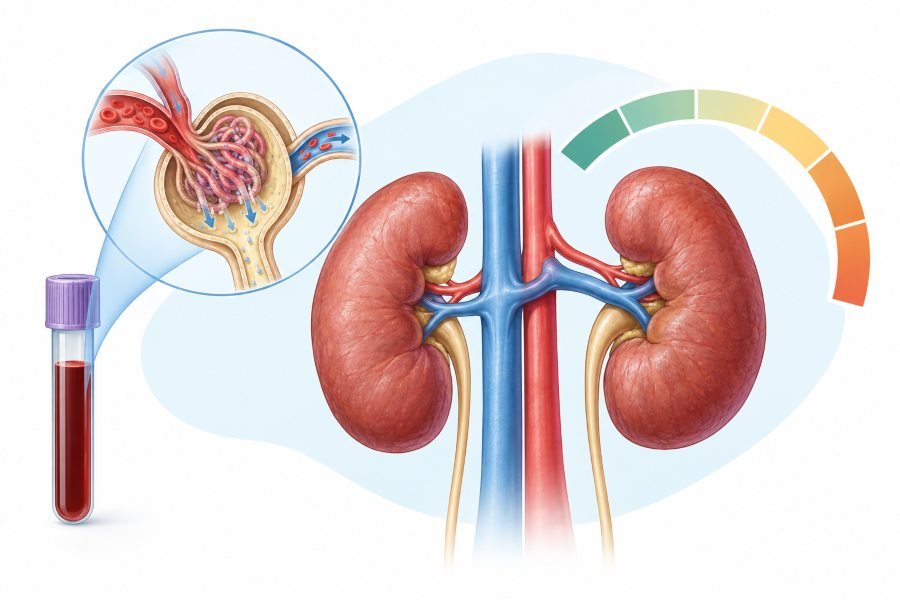
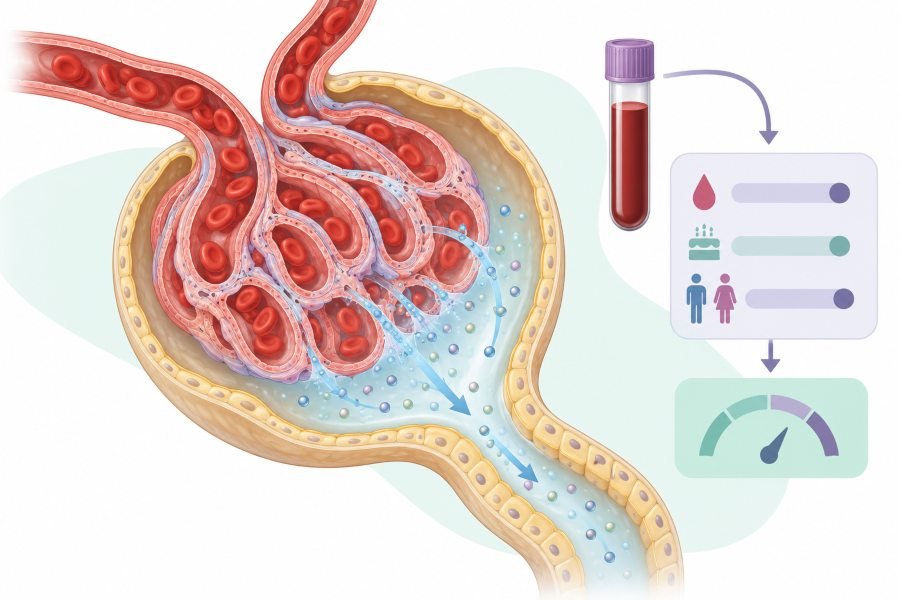
eGFR stands for estimated glomerular filtration rate. It is a calculation rather than a measurement, worked out from your blood creatinine along with your age and sex, and it estimates how much blood your kidneys filter each minute. Lower means less filtering.
Before going near what the stages mean, it helps to clear away four things people reliably assume about this number that are not true. Most of the unnecessary alarm around eGFR comes from one of them.
Four Things Your eGFR Is Not
It is not a measurement. Nobody measured your filtration rate. A formula estimated it from a waste product in your blood, and that formula carries genuine margins of error, particularly at higher values and in people whose body composition differs from the population it was built on.
It is not a diagnosis on its own. Chronic kidney disease requires abnormalities lasting at least three months. A single low reading might reflect dehydration, an infection, a new medication or a short episode of acute kidney injury. The KDIGO 2024 guideline on chronic kidney disease says this explicitly: do not assume chronicity from one abnormal eGFR, because it could be something acute and reversible.
It is not the whole picture of your kidneys. Filtration is only half of what gets assessed. The other half is whether protein is leaking into your urine, and that requires a urine test nobody can do from a blood sample.
It is not supposed to stay at 100 forever. Filtration declines gradually with age in people who never develop kidney disease at all. A number lower than the one you had at twenty-five is expected, not evidence of decline in the pathological sense.
What The Number Is Estimating
What The Number Is Estimating
Creatinine is a waste product your muscles produce at a fairly steady rate, filtered out by the kidneys and passed in urine. When filtering slows, creatinine builds up in the blood. eGFR works backwards from that concentration to estimate filtration, adjusting for age and sex because both affect how much creatinine you generate in the first place.
The equation changed in 2021, when a joint task force recommended removing the race coefficient that had sat inside the older formula for two decades. The National Kidney Foundation eGFR calculator now uses the race-free version, and guidance published in Clinical Chemistry noted that while most people’s results are similar under the new equation, some values differ by more than ten percent. If your number appeared to shift between one year and the next without any change in how you feel, a change in the laboratory’s equation is worth ruling out before anything else.
One more detail hides in the units. eGFR is reported per 1.73 square metres of body surface area, an average-sized adult. For most people that adjustment is invisible. For someone very large or very small it matters, particularly when medication doses are being calculated from it.
Your Stage Has Two Coordinates, Not One
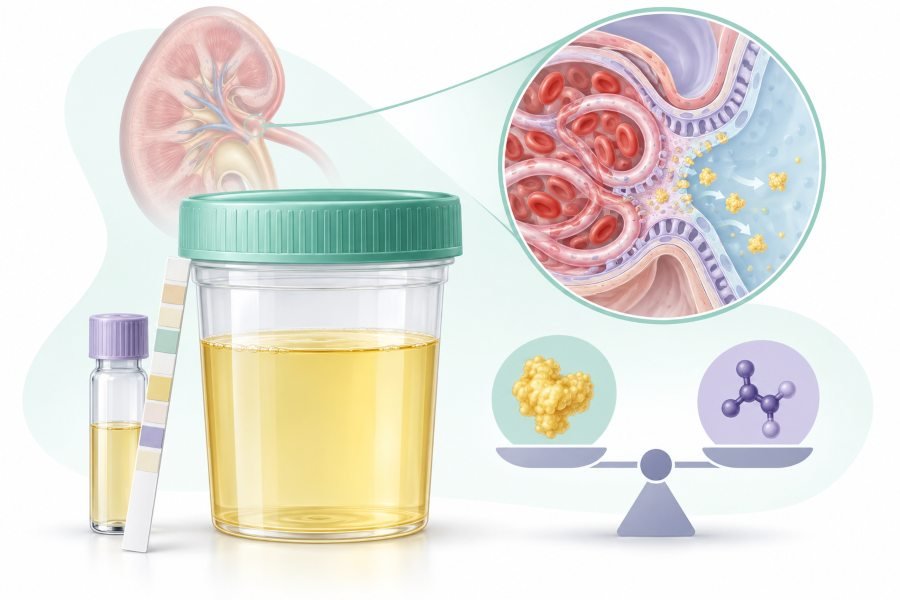
This is the part that changes how you read your own result, and it is routinely left out. Kidney disease is not staged on a single line running from good to bad. It is staged on a grid. One axis is your eGFR, labelled G1 through G5. The other is how much albumin is leaking into your urine, labelled A1 through A3 and measured by a urine albumin to creatinine ratio.
G category
eGFR range
Description
G1
90 or above
Normal or high filtration
G2
60 to 89
Mildly reduced
G3a
45 to 59
Mild to moderately reduced
G3b
30 to 44
Moderately to severely reduced
G4
15 to 29
Severely reduced
G5
Below 15
Kidney failure
The albuminuria axis runs alongside it: A1 is a ratio below 30, A2 is 30 to 300, and A3 is above 300. Two people can both sit at G3a with an eGFR of 52, and if one is A1 and the other is A3, their risk of progression, of cardiovascular events and of kidney failure are not remotely comparable. The higher-albuminuria patient is in a substantially worse position despite the identical blood result.
That is why the NIDDK guidance on testing for chronic kidney disease pairs the blood estimate with a urine test, and why an albumin ratio at or above 30 counts as evidence of kidney damage even when eGFR is perfectly normal. Someone at G1 with A3 has kidney disease. Someone at G2 with A1 usually does not.
If you have diabetes or high blood pressure and have only ever had the blood half done, asking about the urine test is the single most useful thing you can take from this article.
Why 68 At Seventy Is Different From 68 At Thirty
Why 68 At Seventy Is Different From 68 At Thirty
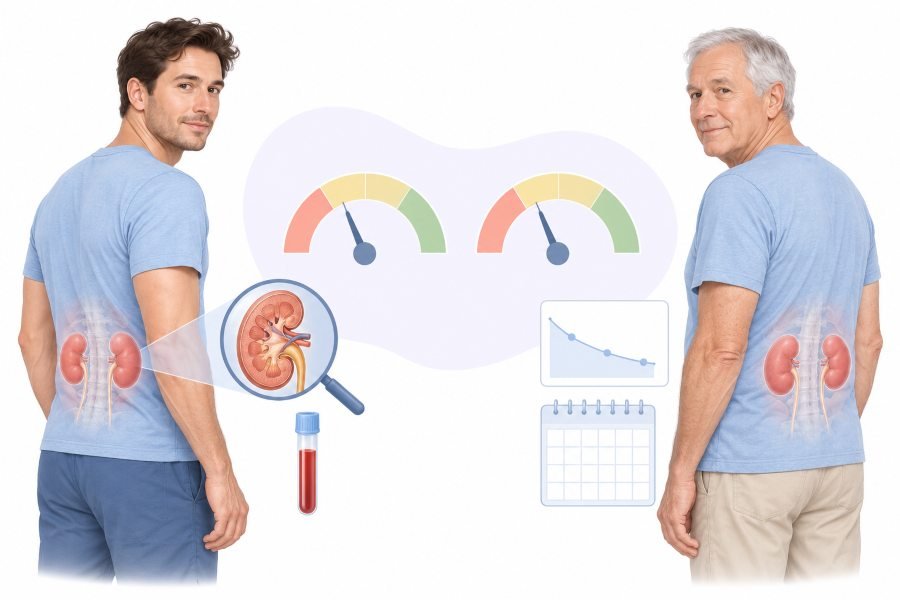
Filtration falls with age even in healthy kidneys, at a rate of roughly one unit a year from around the fourth decade onward. An eGFR in the high sixties or seventies in someone in their seventies is unremarkable in isolation. The same number in someone in their thirties genuinely warrants a look, because it sits well below what that age band would predict.
The three-month rule matters just as much. A single reading taken during a vomiting illness, a week of poor fluid intake, or shortly after starting a new drug can be misleadingly low. The correct response to one unexpected result is usually a repeat, not a referral. What raises real concern is a value that stays down across months, or one accompanied by protein in the urine, or one that is clearly falling from your own previous readings.
Awareness is the bigger problem in the background here. The CDC estimates that more than one in seven American adults has chronic kidney disease, and that as many as nine in ten of them do not know. That is not because the tests are unavailable. It is because early kidney disease produces no symptoms whatsoever, and because the urine half of the assessment gets skipped far more often than the blood half.
When Creatinine Lies
Because eGFR is calculated from creatinine, anything that changes creatinine without changing filtration will move your eGFR in a way that means nothing about your kidneys.
The drug entries deserve particular attention because they cause real clinical confusion. These medicines block the transporters that secrete creatinine into urine, so blood creatinine climbs while the kidneys carry on filtering exactly as before. A review of drugs that raise plasma creatinine without reducing filtration documented this for cimetidine, trimethoprim and several others decades ago, and dedicated studies have since shown that dolutegravir raises creatinine with no effect on measured filtration rate. If your eGFR dropped shortly after starting a new medication, that timing is worth raising rather than assuming the worst.
The opposite error is quieter and arguably more dangerous. An older, frail or malnourished person with very little muscle produces little creatinine, so their eGFR can look comfortably normal while their actual filtration is considerably worse. That is the situation where the blood test flatters and nobody notices.
The Second Test Almost Nobody Gets Offered
The Second Test Almost Nobody Gets Offered
Cystatin C is a different filtration marker, produced by nearly all cells in the body rather than by muscle, and it is not affected by the transporter blockade that trips up creatinine. That makes it a useful cross-check exactly where creatinine is least reliable.
The KDIGO 2024 recommendation goes further than most people realise. As summarised in the Annals of Internal Medicine synopsis of the guideline, where cystatin C is available, the GFR category should be estimated from creatinine and cystatin C combined rather than creatinine alone. In practice, availability is patchy and many labs still do not offer it routinely. It is a reasonable thing to ask about if your eGFR sits near a threshold that will change your treatment, if you have unusually high or low muscle mass, or if the number simply does not fit the rest of your clinical picture.
The Trend Beats The Value
A single eGFR tells you where you are standing. A series tells you which direction you are walking, and the direction is what determines outcomes. A stable 52 across five years is a very different situation from a 52 that was 71 two years ago, even though both produce the same flag on the same printout.
This is the strongest practical argument for keeping copies of your own results. Most people see several clinicians across a decade, records do not always follow them, and nobody is better placed than you to notice that a number has been drifting. Bring the old ones to the appointment. A clinician looking at three values can say something a clinician looking at one simply cannot.
What Actually Protects The Function You Have
What Actually Protects The Function You Have
Kidney tissue does not regenerate, so the aim is preserving what remains rather than restoring what has gone. The interventions with real evidence behind them are unglamorous and mostly not about kidneys at all.
Blood pressure control does more than anything else, which is why it dominates every guideline in this field. Where diabetes is involved, glucose control sits alongside it. Medications from the ACE inhibitor and ARB families protect the kidney beyond their blood pressure effect, particularly when albumin is leaking.
The newer development worth understanding is the SGLT2 inhibitor class, originally diabetes drugs, now used for kidney protection in people without diabetes too. These cause something that alarms people when nobody warns them first: eGFR usually dips slightly in the first weeks of treatment, then stabilises, and the long-term rate of decline is slower than it would have been. That initial dip is expected physiology rather than damage, and stopping the drug because of it is precisely the wrong response.
Then the avoidance list. Regular use of anti-inflammatory painkillers is hard on kidneys already under strain, and a pharmacist can suggest alternatives. Smoking accelerates decline. Dehydration during illness matters, and some clinics advise temporarily pausing certain medications during vomiting or diarrhoea, which is a conversation worth having in advance rather than during. Contrast dye for scans needs your kidney numbers known beforehand.
What does not work is anything marketed as a kidney cleanse or detox. There is no evidence behind them, some herbal preparations are directly nephrotoxic, and high-dose supplements are a recognised cause of kidney injury rather than a remedy for it. Drinking large volumes of water beyond thirst does not improve filtration either.
Signs That Should Not Wait For The Next Blood Test
Passing much less urine than usual, or none
Swelling in the legs, ankles or face, especially with breathlessness
Blood in the urine, or urine that looks persistently foamy
Severe pain in the flank or back with fever
Nausea, vomiting, confusion or unusual drowsiness alongside a known low eGFR
A sudden sharp fall in eGFR after starting any new medication
What Kidneys Ask Of You Over Decades
Kidneys are undramatic organs. They give almost no warning, produce no pain as they decline, and can lose a substantial share of their capacity before anything at all feels different. That silence is the whole reason a routine blood result is often the first and only signal, and it shapes what a sensible response looks like.
Know both of your numbers, the blood one and the urine one, and ask for the second if you have only ever had the first. Keep the results somewhere you can find them, because the trend is where the information lives. Treat blood pressure and blood sugar as kidney matters rather than separate projects, since between them they account for most kidney failure in the world. Tell every clinician you see about every drug and supplement you take, including the ones you bought without a prescription. Go back for the repeat test when you are asked to, because a single number was never going to settle it. And take some reassurance from the shape of the evidence: most people with early reduced filtration never progress to kidney failure, particularly when the contributing conditions are treated properly and early.
Disclaimer
This article is general health information and is not medical advice. It cannot replace an assessment by a clinician who knows your history, your medications and your other results. Estimating equations, reference thresholds and staging systems vary by country and change over time, and no single value should be interpreted in isolation. Do not start, stop or adjust any medication on the basis of a test result alone, including medicines that cause an expected early change in eGFR. Seek urgent medical care for a sudden drop in urine output, swelling with breathlessness, blood in the urine, or confusion alongside known kidney impairment.
References
Kidney Disease: Improving Global Outcomes CKD Work Group. KDIGO 2024 clinical practice guideline for the evaluation and management of chronic kidney disease. Kidney International. 2024;105(4S):S117-S314.
Stevens PE, Ahmed SB, Carrero JJ, et al. Evaluation and management of chronic kidney disease: synopsis of the KDIGO 2024 clinical practice guideline. Annals of Internal Medicine. 2024. doi:10.7326/ANNALS-24-01926
Miller WG, Kaufman HW, Levey AS, et al. National Kidney Foundation Laboratory Engagement Working Group recommendations for implementing the CKD-EPI 2021 race-free equations for estimated glomerular filtration rate. Clinical Chemistry. 2022;68(4):511-520. doi:10.1093/clinchem/hvab278
Andreev E, Koopman MG, Arisz L. A rise in plasma creatinine that is not a sign of renal failure: which drugs can be responsible? Journal of Internal Medicine. 1999;246(3):247-252. PMID 10475992.
Koteff J, Borland J, Chen S, et al. A phase 1 study to evaluate the effect of dolutegravir on renal function via measurement of iohexol and para-aminohippurate clearance in healthy subjects. British Journal of Clinical Pharmacology. 2013;75(4):990-996. doi:10.1111/j.1365-2125.2012.04406.x
Centers for Disease Control and Prevention. Chronic kidney disease basics. Atlanta, GA: CDC.
National Institute of Diabetes and Digestive and Kidney Diseases. Chronic kidney disease tests and diagnosis. Bethesda, MD: NIDDK.
National Kidney Foundation. eGFR calculator and guidance on the CKD-EPI 2021 equations. New York, NY: NKF.
About Dr. Thomas W. Longley, MD Physician
Dr. Thomas W. Longley provides thoughtful family medicine with a practical approach to everyday health concerns and ongoing patient care.




 Cardiologist