Somewhere on social media, someone is always showing off a dramatic before-and-after from a week of drinking nothing but water. The numbers on the scale look impressive, the claims about “resetting” your metabolism sound appealing, and if you’re chasing a fast result, seven days feels like a manageable commitment compared to months of dieting. But a 7-day water fast is not a casual weight-loss trick, and the way it’s often presented online leaves out most of what actually happens to your body during a week without food.
This article walks through what a realistic outcome looks like, what the real risks are, who should never attempt this without medical supervision, and why the “results” people post rarely tell the full story.
What a 7-Day Water Fast Actually Involves
What a 7-Day Water Fast Actually Involves
A water fast means consuming nothing but water for the entire period, no food, no juice, no tea, no calorie-containing drinks of any kind. Some medically supervised protocols allow small, carefully measured electrolyte additions, but a true water fast by definition excludes everything except water itself.
This is different from intermittent fasting, which typically involves shorter eating windows within a day, or from a modified fast that still allows very low-calorie intake. A full week without any food is a much more significant physiological event, and it’s treated very differently by medical professionals than shorter fasting approaches.
What Happens Inside Your Body During the Week
Your body doesn’t handle a week without food the same way it handles skipping a meal or two. There’s a clear, well-documented sequence of changes.
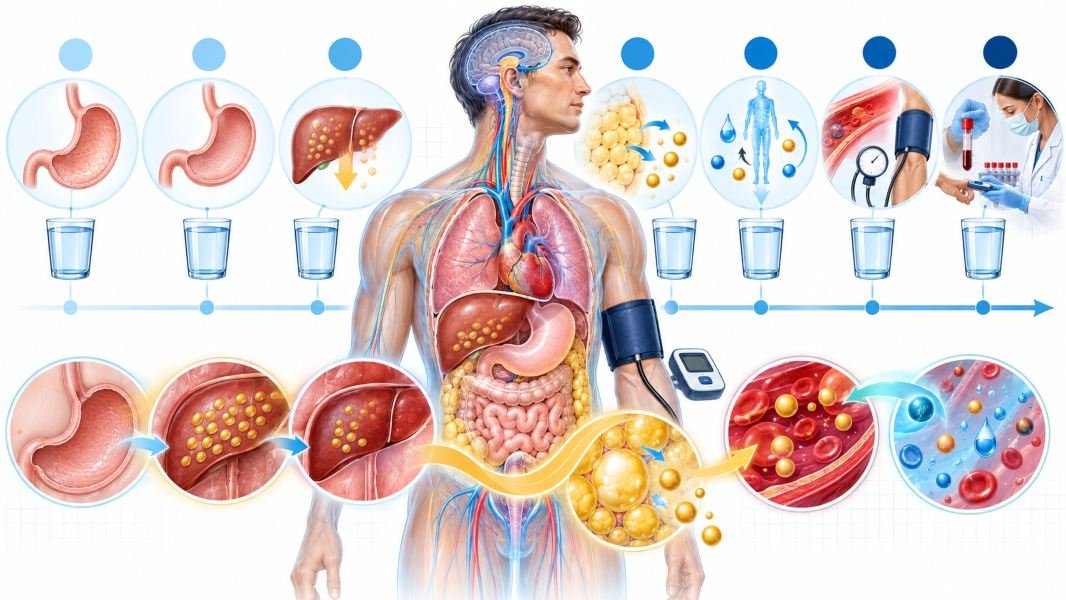
The first day or two your body is still relying mainly on stored glucose (glycogen) in the liver and muscles. As that runs low, your body shifts toward burning fat for fuel, a metabolic state called ketosis, which typically becomes noticeable by day two or three.
Water weight drops quickly. A large portion of the early “weight loss” people see on the scale isn’t fat at all. As glycogen stores empty, they release the water bound to them, which is why the first few days often show a bigger number than the fat loss alone would explain.
Muscle breakdown begins. Without incoming protein, your body starts breaking down muscle tissue for the amino acids it needs to keep essential functions running. This is one of the more overlooked downsides of extended fasting, since it means some of the “results” people see come at the cost of lean tissue, not just fat.
Electrolytes shift. Sodium, potassium, and magnesium levels change as the body adapts to running without food, which is part of why symptoms like fatigue, headaches, muscle cramps, and lightheadedness are so commonly reported during extended water fasts.
What Kind of Weight Loss Results to Realistically Expect
What Kind of Weight Loss Results to Realistically Expect
People searching for “7 day water fast results” are usually hoping for a specific number, but that’s exactly where the most misleading claims tend to show up. A meaningful chunk of the scale change in the first several days reflects water and glycogen loss rather than fat, and that portion typically returns once normal eating resumes. Muscle loss also factors into the total number in ways that don’t show up as a win for body composition.
Because the balance between water, muscle, and fat loss varies so much between individuals, and because the health risks scale up the longer the fast continues, this isn’t the kind of thing where a specific target or day-by-day expectation can be responsibly laid out here. If tracking measurable, medically appropriate weight loss is the goal, that’s a conversation to have directly with a doctor or registered dietitian, who can account for your health history, medications, and what’s actually safe for your body.
The Real Risks of a Week-Long Water Fast
This is the part that gets glossed over in most “results” content, and it’s the part that actually matters most.
Dehydration and electrolyte imbalance. Even though you’re drinking water, your body can still lose critical electrolytes faster than plain water replaces them, which can affect heart rhythm, muscle function, and nerve signaling.
Muscle loss. As mentioned above, extended fasting doesn’t only burn fat. A meaningful share of the tissue broken down for fuel is muscle, which can affect strength, metabolism, and overall physical function.
Low blood pressure and dizziness. Fatigue, lightheadedness, and fainting are common complaints during multi-day fasts, and they raise real safety concerns around driving, operating machinery, or simply standing up too quickly.
Gallstones. Rapid weight loss of any kind, including from fasting, is a recognized risk factor for gallstone formation, since the gallbladder empties less frequently when no fat is being eaten.
Refeeding syndrome. This is arguably the most dangerous and least publicized risk. According to the Cleveland Clinic’s overview of refeeding syndrome, when someone who has been under-eating for an extended period starts eating again, especially if food is reintroduced too quickly, it can trigger dangerous shifts in the body’s electrolyte levels. These shifts can affect the heart, lungs, muscles, and brain, and in severe cases can be life-threatening. The risk climbs specifically with fasts lasting a week or longer, which makes the end of a 7-day water fast just as risky as the fast itself if it isn’t handled carefully.
Effects on existing health conditions. People with diabetes, gout, heart conditions, kidney disease, or a history of disordered eating face substantially elevated risks from prolonged fasting, and for some of these groups, water fasting without medical oversight isn’t just risky, it can be genuinely dangerous.
Who Should Not Attempt This Without Medical Supervision
Who Should Not Attempt This Without Medical Supervision
A number of groups face meaningfully higher risk from extended water fasting, and going without professional oversight isn’t a reasonable option for them:
People with type 1 or type 2 diabetes, due to serious blood sugar risks
Anyone with a current or past eating disorder
People with gout, since fasting can trigger flare-ups
Those with kidney disease or a history of kidney stones
People with heart conditions or a history of arrhythmia
Pregnant or breastfeeding individuals
Older adults, who often have less physiological reserve to draw on
Anyone taking medications that require food intake or that affect blood sugar, blood pressure, or electrolyte levels
Children and teenagers, whose growing bodies have different nutritional needs entirely
If you fall into any of these categories, a conversation with your doctor isn’t just a formality here, it genuinely changes whether this is safe to consider at all.
Safety Tips If You’re Considering It Anyway
Given how much risk is concentrated specifically in extended, unsupervised fasting, the single most protective thing you can do is not go into a 7-day water fast alone. A few general safety principles are worth knowing regardless:
Talk to a doctor first, not after. Baseline bloodwork and a conversation about your specific health history can catch risk factors you might not know you have.
Never jump straight into a full week. Attempting a multi-day fast without ever having tried a shorter one first removes any sense of how your body responds, which is information you want before, not during, a longer attempt.
Watch for warning signs that mean stopping immediately. Severe dizziness, fainting, chest pain, an irregular heartbeat, confusion, or extreme weakness are all reasons to end a fast and seek medical attention, not signs to push through.
Refeed slowly and carefully, ideally with guidance. Given how real the risk of refeeding syndrome is, how you come off a multi-day fast matters just as much as the fast itself, and this is another area where professional guidance is genuinely protective rather than optional.
Don’t fast alone if you can avoid it. Having someone aware of what you’re doing, who can recognize concerning symptoms and get you help if needed, adds a real layer of safety.
Is It Actually an Effective Long-Term Weight Loss Strategy
Is It Actually an Effective Long-Term Weight Loss Strategy
Even setting the safety concerns aside, water fasting has a structural problem as a weight-loss method: a large share of what’s lost tends to return once normal eating resumes, particularly the water weight and some of the muscle-related loss. Because it isn’t a sustainable everyday eating pattern, it doesn’t build the habits that actually predict long-term weight maintenance, things like consistent nutrition, regular movement, and manageable portion control. For many people, the dramatic short-term number ends up being a less meaningful measure of progress than it appears on social media.
When to Consider Other Approaches
If the underlying goal is genuine, lasting weight loss rather than a fast before-and-after photo, it’s worth having a conversation with a doctor or registered dietitian about approaches that are both sustainable and appropriate for your specific health picture. This might include structured calorie management, shorter and better-studied fasting windows, or addressing underlying factors like sleep, stress, or medical conditions that can make weight loss harder than it should be.
This article is for general informational purposes only and is not a substitute for professional medical advice. Extended fasting carries real health risks and should not be attempted without consulting a qualified healthcare provider, particularly if you have any existing medical condition, take regular medication, or have a history of disordered eating. If you experience severe symptoms during or after fasting, including fainting, chest pain, confusion, or an irregular heartbeat, seek medical care immediately.
About Doctiplus Doctors Staff
Doctiplus is a trusted global digital health platform that connects patients worldwide with certified doctors for instant online consultations and in person appointments.









 Cardiologist