You get a text saying your results are ready. You log in, and there are fourteen lines of numbers with one of them highlighted in a colour that feels deliberately alarming. The appointment to discuss it is next Thursday. That gap, between seeing the flag and hearing what it means, is where most people meet the comprehensive metabolic panel properly for the first time.
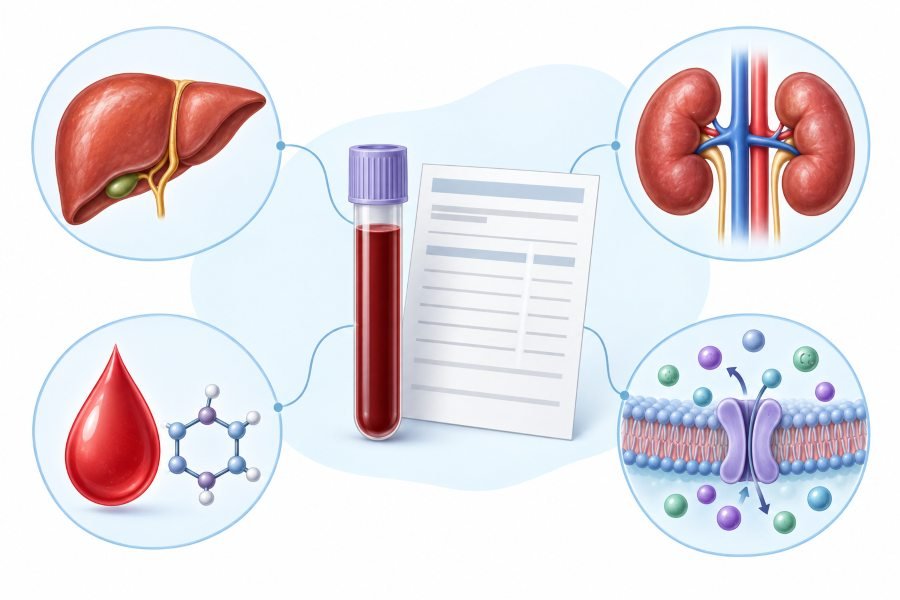
A CMP is a single tube of blood that returns fourteen measurements spanning blood sugar, kidney function, liver chemistry, electrolytes, calcium and blood proteins. It is ordered so widely precisely because it is broad. It was never designed to answer one question, which is why reading it like a report card, line by line, pass or fail, leads people to conclusions the test cannot support.
The Fourteen Numbers At A Glance
Reading them in groups instead of top to bottom is the single biggest improvement you can make to how you interpret your own printout. The MedlinePlus overview of the comprehensive metabolic panel covers what each measurement is for.
Group
Tests
What the group is watching
Blood sugar
Glucose
Energy handling, diabetes risk
Kidney
BUN, creatinine, usually a calculated eGFR
Filtering capacity, hydration
Liver chemistry
ALT, AST, ALP, total bilirubin
Liver and bile duct irritation
Proteins
Albumin, total protein
Nutrition, liver output, inflammation
Electrolytes
Sodium, potassium, chloride, bicarbonate
Fluid balance, nerve and heart function
Mineral
Calcium
Bone, nerve, muscle and heart signalling
A basic metabolic panel is the same thing minus the liver and protein rows, so eight tests rather than fourteen. Neither version includes a blood count, cholesterol, thyroid tests, HbA1c, ferritin, vitamin B12 or vitamin D, which catches people out given the word comprehensive is sitting right there in the name.
Why Almost Everyone Has Something Flagged
Why Almost Everyone Has Something Flagged
Here is the part nobody explains, and it defuses most of the worry on its own. A laboratory reference range is built to contain the middle ninety-five percent of results from a healthy reference population. That design guarantees one healthy person in twenty falls outside it on any given test, with nothing wrong at all. The range is a statistical boundary, not a line between health and disease.
Now apply that across fourteen tests drawn at once. If each carried an independent one in twenty chance of being flagged, the odds of a healthy person getting at least one flag work out at roughly one in two. The true figure is not exactly that, since these values influence each other and some ranges are set differently, but the scale of it holds. A single flagged number on a fourteen-item panel is the expected outcome rather than the exception.
What changes that reading is magnitude, pattern and direction of travel. A value sitting a hair outside its boundary means something very different from one at twice the upper limit. Several related values moving together tell a story that one lone outlier does not. And a number that has drifted over three annual panels carries more information than any single result, which is the strongest argument for keeping your own copies.
This is also why running broad panels on people with no symptoms is less obviously helpful than it sounds. Each incidental abnormality tends to summon another test, and the chain that follows can carry cost, anxiety and occasionally real risk without anyone ending up healthier.
Start With The Kidneys
Creatinine is waste from ordinary muscle turnover, cleared by your kidneys, so it climbs when filtering falls. The complication is that how much creatinine you make depends on how much muscle you carry. A heavily built twenty-five year old and a frail eighty year old with identical kidney function will not produce identical creatinine values, and that is before you account for creatine supplements or a high protein diet, both of which raise it without anything being wrong.
That is why labs report a calculated eGFR alongside it, folding in age and sex. The equation changed in 2021, when a joint task force recommended removing the race coefficient that had been built into the older formula, and the National Kidney Foundation eGFR calculator now uses the race-free version. Laboratory guidance published in Clinical Chemistry noted that most people’s results are similar under the new equation, though some differ by more than ten percent, which explains an apparent shift in someone whose kidneys have not changed at all.
BUN is the third kidney number and the least specific. It rises with dehydration, a high protein intake, steroids and gastrointestinal bleeding as readily as with kidney trouble, which is why clinicians look at its ratio to creatinine rather than the value alone.
The larger point is that blood tests give an incomplete picture of kidney health full stop. Damage often shows first as albumin leaking into urine, well before filtration measurably falls. Guidance from the NIDDK on testing for chronic kidney disease pairs the blood estimate with a urine albumin to creatinine ratio. If you have diabetes or high blood pressure, that urine test is the one to ask about.
The Liver Section Is Badly Named
The Liver Section Is Badly Named
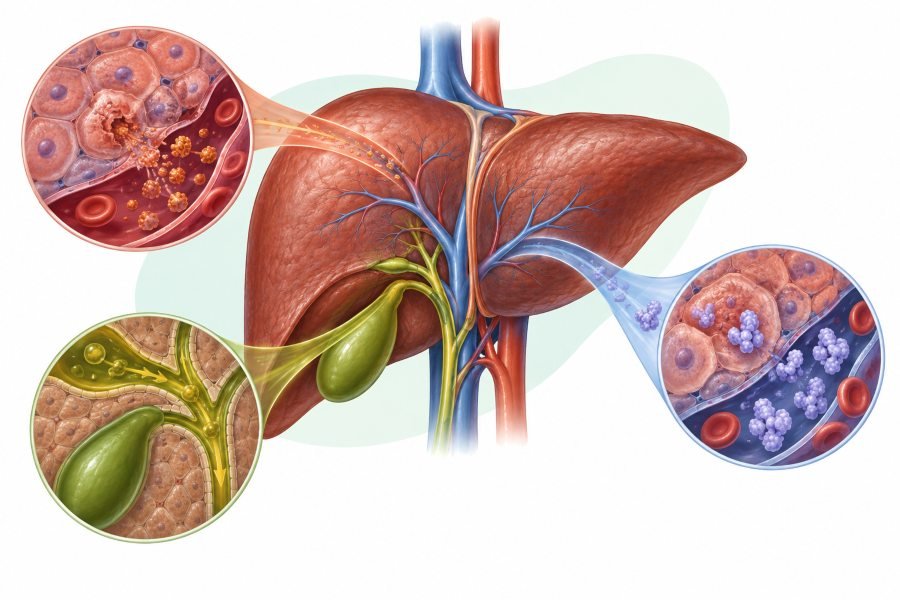
Most people call these liver function tests. Specialists have been pushing back on that for years, because ALT, AST, ALP and bilirubin do not measure how well your liver is working. They detect irritation and leakage. The American College of Gastroenterology guideline on abnormal liver chemistries argues for calling them liver chemistries, and opens with advice patients almost never hear: before starting any investigation, repeat the panel to confirm the abnormality is actually there.
ALT is the most liver-specific of the four. AST comes from liver, muscle and heart, so a hard gym session two days before your blood draw can lift it. ALP arrives from liver, bile ducts and bone, which is why a raised ALP in a growing teenager or a pregnant woman reads very differently from the same number in a sixty year old. Bilirubin is the breakdown product of old red cells, and an isolated mild elevation with everything else normal is frequently Gilbert syndrome, a harmless inherited quirk of bilirubin processing that affects a meaningful slice of the population and needs nothing done about it.
Two things about the ALT range deserve attention. The guideline defines a genuinely healthy ALT as below roughly 29 to 33 for men and 19 to 25 for women, which sits under the upper limit many laboratories print. A result marked normal can therefore still be worth a conversation if you have risk factors. And the relationship between the two transaminases matters as much as either number, since ALT running above AST points somewhere different from AST running at twice ALT.
Then the caution that runs the other way. Normal liver chemistries do not rule out liver disease. Significant scarring can sit behind a completely unremarkable set of enzymes, which is why these numbers inform a picture rather than settle one.
Potassium Is The Number Most Likely To Be Simply Wrong
Potassium Is The Number Most Likely To Be Simply Wrong
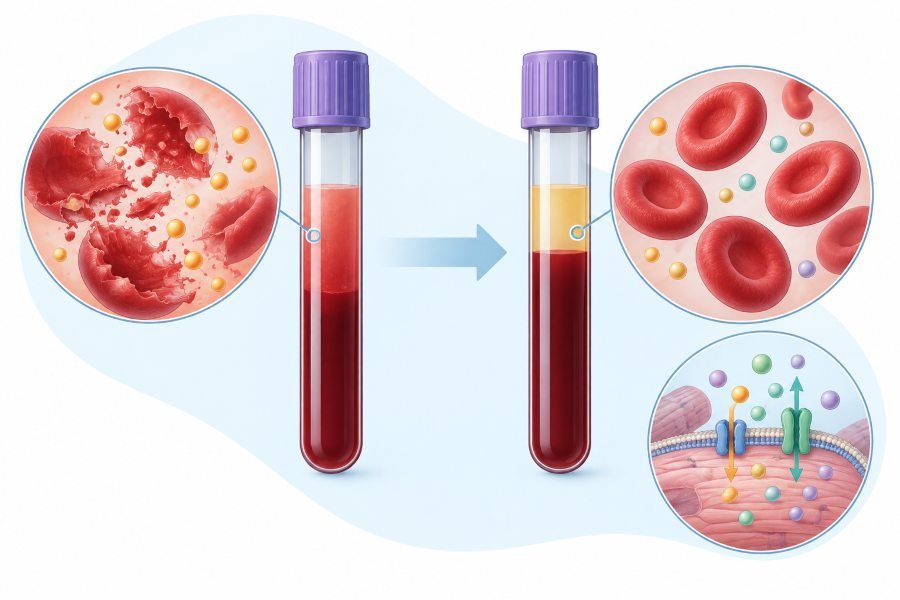
Electrolytes are where genuinely urgent abnormalities live, and also where false ones are most common. If red cells are damaged during a difficult draw, they spill potassium into the tube, and the analyser reports what it finds without knowing the cause. Clenching your fist repeatedly or a tourniquet left on too long can do the same. A carefully drawn repeat sample resolves most startling potassium results.
Sodium trips people up differently. Abnormal sodium usually reflects water balance rather than salt intake, so the instinct to blame your diet is almost always the wrong first move. Bicarbonate, often labelled CO2 on the printout, falls when acid builds up and rises after prolonged vomiting or with certain diuretics.
If your clinic rings you the same day about an electrolyte value, that is the system working rather than evidence of disaster. Severe potassium or sodium abnormalities produce real symptoms, palpitations, marked weakness, confusion, and they are handled quickly for good reason.
Glucose Is A Snapshot, Not A Verdict
Glucose Is A Snapshot, Not A Verdict
One raised fasting glucose does not diagnose diabetes. The CDC guidance on diabetes testing places a fasting result of 99 or below in the normal band, 100 to 125 in the prediabetes band, and 126 or above in the diabetes band, with confirmation normally requiring a repeat or a second type of test. HbA1c is usually the more useful follow-up, because it averages months rather than capturing one morning after a poor night’s sleep. Prediabetes is common and often undetected, and the StatPearls overview of prediabetes is a reasonable read on what that intermediate range actually signifies, which is raised risk rather than established disease.
Calcium Has A Catch Worth Knowing
About half the calcium in your blood travels bound to albumin. When albumin is low, total calcium falls with it, and nothing is wrong with your calcium status at all. Clinicians use a corrected calcium or an ionised calcium to see past this. A genuinely raised calcium, confirmed on a repeat, usually leads to a parathyroid hormone test. And none of it tells you anything about your bone density, which is measured a different way entirely.
What Actually Moves These Numbers On The Day
Worth knowing before you conclude anything, because several of these explain a result completely.
A meal beforehand, which lifts glucose above all else, hence the usual request to fast eight to twelve hours with water allowed
Dehydration, which concentrates almost everything, particularly sodium, BUN and albumin
Hard exercise in the previous day or two, which raises AST and other enzymes from muscle
Creatine supplements and high protein intake, which raise creatinine with no kidney problem present
Medications including diuretics, steroids and several blood pressure drugs
Herbal and bodybuilding supplements, a documented cause of liver injury that rarely gets mentioned unless you volunteer it
Pregnancy, which legitimately shifts several reference points
Four Questions Worth Asking Before Thursday
Is this one number or a pattern? One flagged value in isolation is the commonest result in medicine. Three related values moving the same direction is a different conversation.
How far outside is it? Crossing the boundary by a fraction and sitting at double the upper limit are not the same finding, even though the printout flags both identically.
What did my last panel say? Your own trend is more informative than the population range. If you have older results, bring them.
Should this just be repeated? Often yes, and that is not your doctor fobbing you off. It is the first step in the relevant guideline.
Alongside those, ask whether anything you take could explain it, and whether you need a urine test as well given your blood pressure and blood sugar.
Some things do not wait for the appointment at all. Yellowing of the eyes or skin, pale stools with dark urine, severe abdominal pain, persistent vomiting, confusion, palpitations with marked weakness, passing very little urine, or swelling with breathlessness all need urgent assessment regardless of what any number said.
The Habits That Show Up On Your Next Panel
The Habits That Show Up On Your Next Panel
A chemistry panel is partly a readout of how your organs have been treated over the preceding months, and several values respond faster than people expect.
Alcohol is the big one. It is the most common modifiable reason for abnormal liver chemistries, and it is chronically underestimated when people are asked in a clinic room. An honest number given to your doctor changes what gets investigated and what does not.
Waist size and weight matter too, since fat accumulating in the liver is now the leading cause of mildly raised ALT across much of the world, and it responds well to modest weight loss sustained over months rather than dramatic loss over weeks. Regular movement improves how your body handles glucose independently of what the scales show, though heavy exercise in the day before a blood test can raise enzymes and is worth skipping.
Beyond that, the useful habits are unglamorous. Drink enough water on ordinary days, because chronic mild dehydration shows up across several values at once. Go easy on routine anti-inflammatory painkillers if you have any kidney concern, and ask a pharmacist rather than assuming over the counter means harmless. Review long-term medications with your prescriber periodically, since some are monitored precisely through this panel. Keep your own copies of every result. And book the repeat test you were told to have, because in this corner of medicine the second result is usually where clarity arrives.
Disclaimer
This article is general health information and is not medical advice. It cannot replace an assessment by a clinician who knows your history, your medications and your examination findings. Reference ranges differ between laboratories, units differ between countries, and no single value should be interpreted in isolation. Do not start, stop or adjust any medication or supplement on the basis of a test result alone. Seek urgent medical care for jaundice, severe abdominal pain, confusion, palpitations with weakness, or a sudden drop in how much urine you are passing.
References
Kwo PY, Cohen SM, Lim JK. ACG clinical guideline: evaluation of abnormal liver chemistries. American Journal of Gastroenterology. 2017;112(1):18-35. doi:10.1038/ajg.2016.517
Miller WG, Kaufman HW, Levey AS, et al. National Kidney Foundation Laboratory Engagement Working Group recommendations for implementing the CKD-EPI 2021 race-free equations for estimated glomerular filtration rate. Clinical Chemistry. 2022;68(4):511-520. doi:10.1093/clinchem/hvab278
Charles K, Lewis MJ, Montgomery E, Reid M. The 2021 Chronic Kidney Disease Epidemiology Collaboration race-free estimated glomerular filtration rate equations in kidney disease: leading the way in ending disparities. Health Equity. 2024. doi:10.1089/heq.2023.0038
Prediabetes. In: StatPearls. Treasure Island, FL: StatPearls Publishing. NCBI Bookshelf ID NBK459332.
Centers for Disease Control and Prevention. Diabetes testing. Atlanta, GA: CDC.
National Institute of Diabetes and Digestive and Kidney Diseases. Chronic kidney disease tests and diagnosis. Bethesda, MD: NIDDK.
National Kidney Foundation. eGFR calculator and guidance on the CKD-EPI 2021 equations. New York, NY: NKF.
US National Library of Medicine. Comprehensive metabolic panel (CMP). MedlinePlus medical tests.
About Dr. Thomas W. Longley, MD Physician
Dr. Thomas W. Longley provides thoughtful family medicine with a practical approach to everyday health concerns and ongoing patient care.







 Cardiologist