Most people meet the word “ovulation” in one of three situations. They are trying to get pregnant, and someone tells them to time things properly. They are trying very hard not to get pregnant. Or a clinician asks whether they are ovulating and they realize they have no idea how they would know.
None of those situations is well served by the diagram in a school textbook, which usually shows a tidy 28-day cycle with an arrow pointing at day 14. Real bodies are less obliging. This guide covers what ovulation actually is, where it sits in your cycle, how to tell whether it is happening in yours, and what it means when it is not.
What Ovulation Actually Is
What Ovulation Actually Is
Ovulation is the release of a mature egg from an ovary.
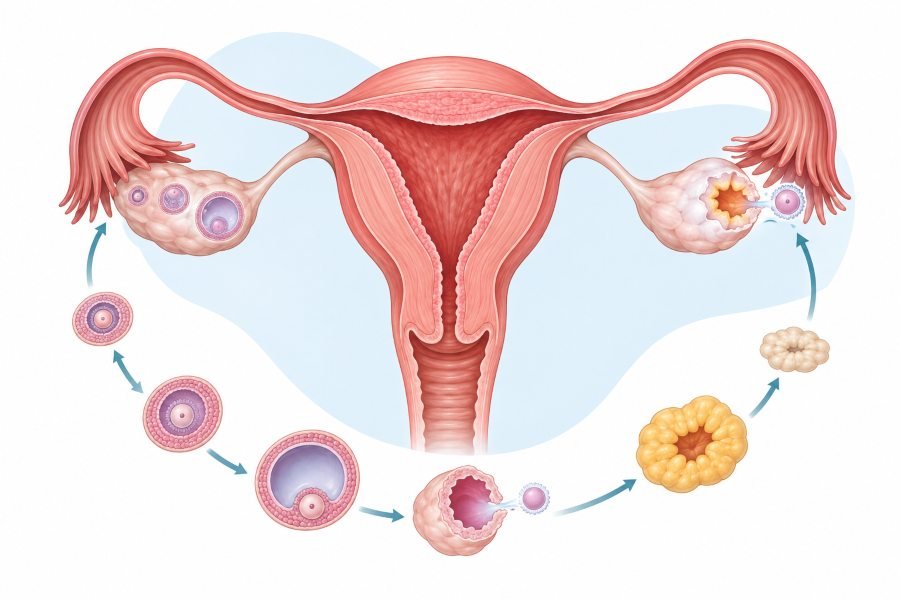
That sounds simple, and the moment itself takes only minutes, but the build-up runs for about two weeks. Here is the chain of events:
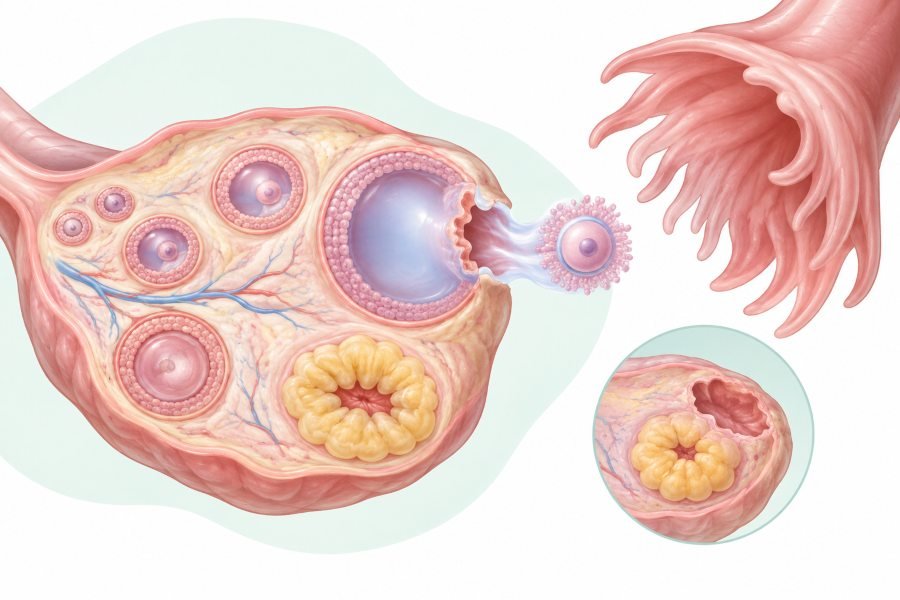
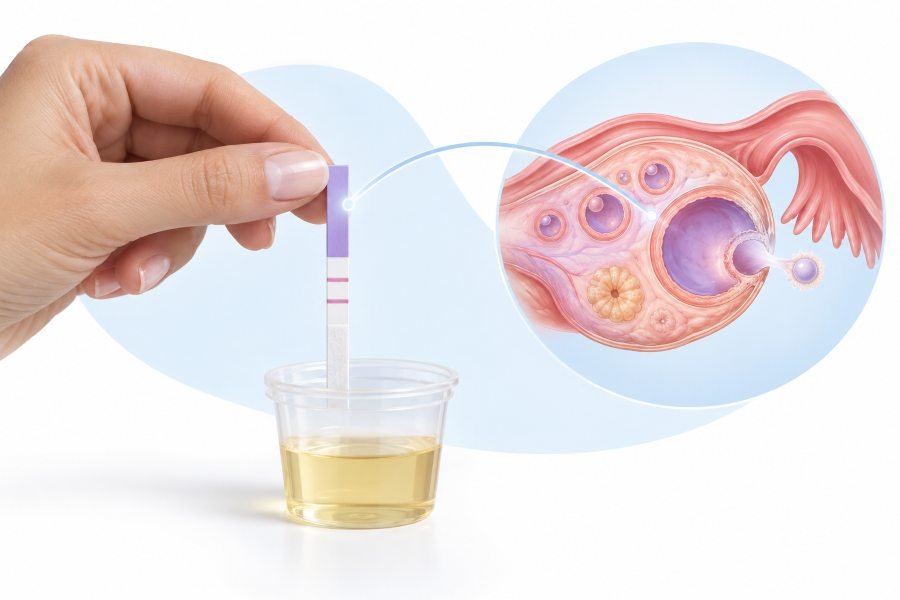
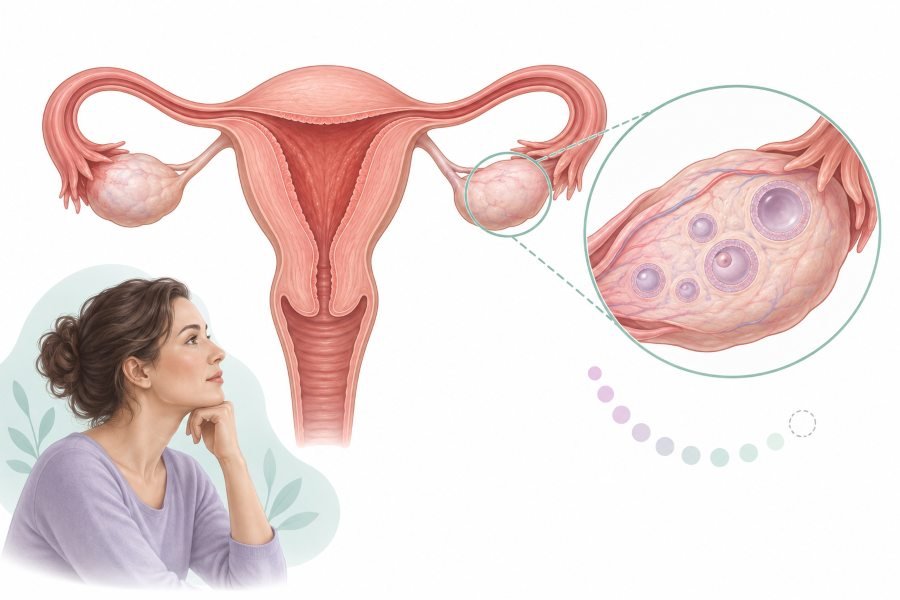
At the start of your cycle, the pituitary gland in your brain releases follicle-stimulating hormone, which tells a group of fluid-filled sacs in your ovaries, called follicles, to start maturing. Each one contains an immature egg.
Usually one follicle pulls ahead of the rest. As it grows, it produces rising amounts of estrogen.
When estrogen crosses a threshold and stays there, it flips a switch in the brain. The pituitary fires off a sharp burst of luteinizing hormone, known as the LH surge.
Roughly 24 to 36 hours after that surge begins, the follicle ruptures and releases its egg. Fine, finger-like projections at the end of the fallopian tube sweep it inside.
The empty follicle does not disappear. It becomes a temporary hormone gland called the corpus luteum, which produces Progesterone to thicken and stabilize the uterine lining.
If the egg is fertilized and implants, the corpus luteum keeps going until the placenta takes over. If not, it breaks down after roughly two weeks, Progesterone falls, and the lining sheds as a period. Cleveland Clinic’s overview of the ovulation process and its signs is a good visual companion if you want to see the sequence mapped out.
The important takeaway: ovulation is not a phase you spend days in. It is a single event that divides your cycle in two.
Where Ovulation Sits In Your Cycle
Phase
Roughly When
What Is Happening
What You Might Notice
Menstrual
Days 1 to 5
Lining sheds, hormones at their lowest
Bleeding, cramping
Follicular
Day 1 to ovulation, length varies a lot
Follicles mature, estrogen climbs
Mucus becomes wetter as estrogen rises
Ovulation
A single event
LH surge, then egg release
Clear stretchy mucus, sometimes one-sided twinges
Luteal
Ovulation to next period, usually 12 to 14 days
Progesterone rises, then falls if no pregnancy
Drier mucus, breast tenderness, premenstrual symptoms
A cycle is counted from the first day of full Bleeding, not from the day spotting starts. For adults, anything from 21 to 35 days is generally considered a typical cycle length, with 28 days being an average rather than a target. NICHD describes the menstrual cycle as a broad indicator of health. That framing is useful: a cycle that has quietly changed pattern is information worth paying attention to, not just an inconvenience.
Why “Day 14” Refuses To Die, And Why You Should Ignore It
Why “Day 14” Refuses To Die, And Why You Should Ignore It
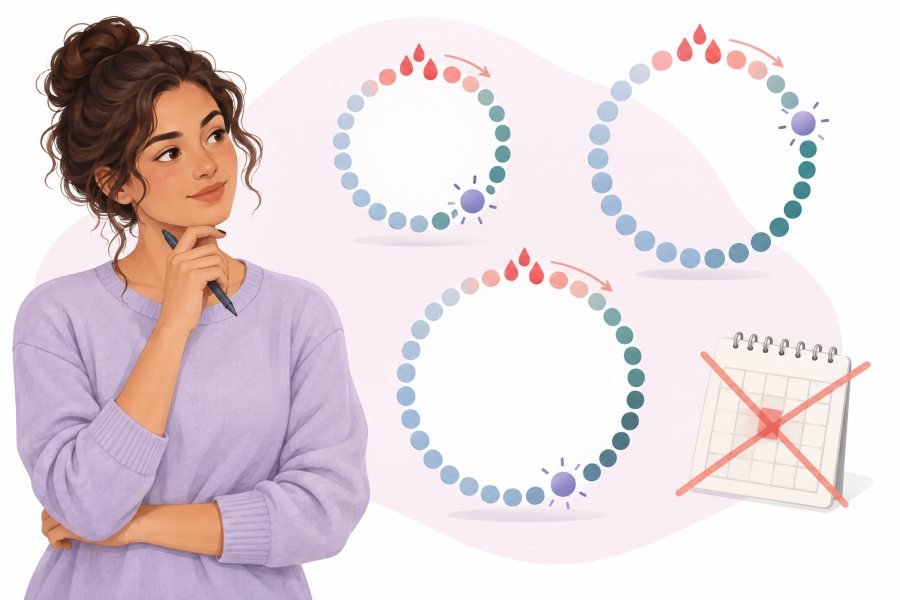
Here is the part that surprises people most. The half of your cycle that varies is the first half, not the second.
The luteal phase, from ovulation to your next period, is relatively consistent for most people at around 12 to 14 days. The follicular phase is the flexible one. Illness, travel, stress, a disrupted sleep schedule, or intense training can all delay the follicle from maturing, which pushes ovulation later. Your period then arrives late, not because your luteal phase stretched, but because ovulation was postponed.
This is why counting forward from day one is unreliable and counting backward from your next period works better. The NHS puts the practical range clearly: ovulation usually happens around 10 to 16 days before your period starts. On a 35-day cycle, that is somewhere near day 21, not day 14. On a 24-day cycle, it may be close to day 10.
Two practical consequences follow. If your cycles are regular, you can estimate reasonably well. If they are not, calendar maths alone will mislead you, and you need body signs instead.
Fertile Window Is Wider Than Ovulation Itself
Fertile Window Is Wider Than Ovulation Itself
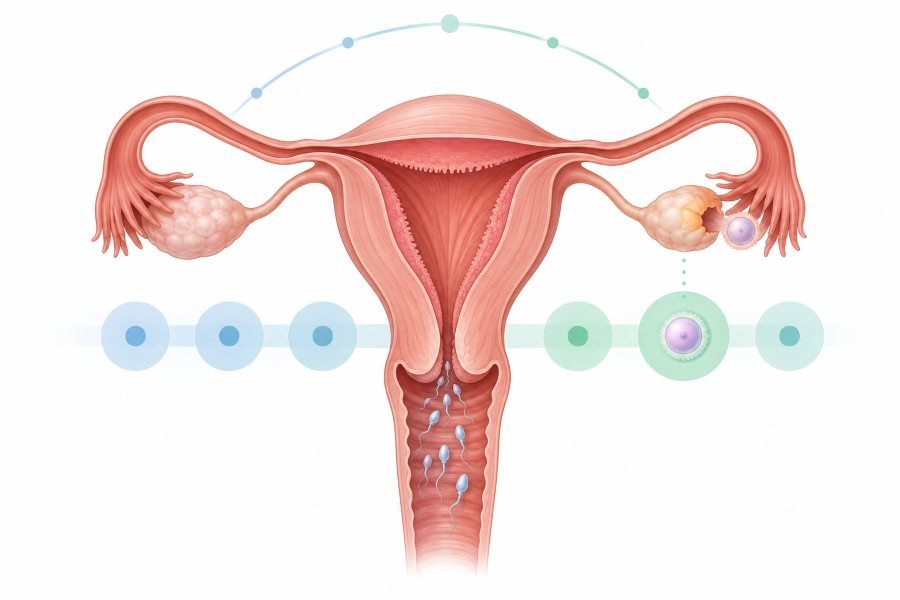
An egg can be fertilized for roughly 12 to 24 hours after release. Sperm are the hardier partner, surviving in the reproductive tract for about three to five days under favourable conditions.
Put those together, and the fertile window works out at about six days: the five days before ovulation plus the day itself. Crucially, most of that window sits before the egg appears. The days with the highest chance of conception are the two or three immediately before ovulation, not the day after.
Mayo Clinic’s guidance on timing intercourse around ovulation signs reflects this, suggesting regular sex from a few days before ovulation through the day after. If you cannot pinpoint ovulation at all, having sex every two to three days across the cycle covers the window without requiring you to predict anything. That approach removes a great deal of stress, and stress is an underrated cost of trying to conceive.
How To Tell Whether You Are Ovulating
No single method does everything. Each one answers a different question.
Method
What It Tells You
Timing
Main Limitation
Cervical mucus
Fertile window is opening
Predicts, several days ahead
Subjective, affected by medication, lubricant, and infection
Ovulation predictor kits
LH surge detected
Predicts, 12 to 36 hours ahead
A surge does not prove an egg was actually released
Basal body temperature
Ovulation already happened
Confirms, after the fact
Useless for timing this cycle, disrupted by illness or poor sleep
Mid-luteal progesterone blood test
Ovulation occurred
Confirms, about a week before the next period
Requires a clinician and correct timing
Serial ultrasound
Follicle growth and collapse
Real time
Clinical setting only
Cervical Mucus
The most useful free signal you have. As estrogen rises, mucus shifts from scant and sticky to wet, clear, and stretchy, often compared to raw egg white. That change is your body preparing a hospitable route for sperm. After ovulation, Progesterone makes it thicken and dry up quickly.
Check at the same time daily, and remember that semen, lubricants, arousal fluid, and some infections can all muddy the reading.
Ovulation Predictor Kits
Ovulation Predictor Kits
These detect the LH surge in urine, giving you roughly a day to a day and a half of warning. Test in the afternoon or early evening rather than first thing, since LH often becomes detectable in urine later in the day, and avoid drinking large volumes of fluid beforehand.
Two honest caveats. People with polycystic ovary syndrome frequently have chronically elevated LH and can get repeated positives without ovulating. And in some cycles a follicle surges but never releases its egg, so a positive test is a strong signal rather than proof. The American Society for Reproductive Medicine’s patient sheet on methods of detecting ovulation lays out where each method’s certainty ends.
Basal Body Temperature
Progesterone raises your resting temperature slightly, usually by around 0.2 degrees Celsius, which is roughly half a degree Fahrenheit. Taken at the same time each morning before getting out of bed, a sustained shift tells you ovulation has already occurred.
This is genuinely useful for confirming a pattern over two or three cycles, and for measuring your luteal phase length. It is close to useless for catching this month’s window, because by the time the temperature rises, the egg is usually gone.
Signs That Get Oversold
Some people feel a one-sided ache around ovulation, known as mittelschmerz. Others notice breast tenderness, light spotting, bloating, or a shift in libido. These are real, but they are inconsistent between people and between cycles, so treat them as supporting evidence rather than a method.
When Ovulation Does Not Happen
When Ovulation Does Not Happen
Occasional anovulatory cycles are normal, particularly in the first years after periods begin and during perimenopause. Persistent anovulation is different, and it usually announces itself through the cycle rather than through any dramatic symptom.
Signals worth taking seriously include cycles consistently shorter than 21 days or longer than 35, cycles that vary wildly in length month to month, periods that stop for three months or more, or bleeding that is unpredictable in timing and volume.
Common underlying causes include polycystic ovary syndrome, thyroid disorders, elevated prolactin, and hypothalamic suppression from low energy availability, heavy training loads, significant weight change, or sustained stress. PCOS is the most frequent cause of ovulatory infertility, and ACOG’s patient explanation of how PCOS disrupts ovulation is a sensible starting point if irregular cycles plus acne or unwanted hair growth sound familiar.
Most of these causes are treatable. The barrier is usually that irregular cycles get normalized for years before anyone investigates them.
What Tracking Can And Cannot Do For Contraception
This deserves its own section, because it is where informal tracking causes real harm.
A period app that predicts ovulation from your past cycle lengths is not contraception. Those predictions are averages; they assume a regularity many people do not have, and studies comparing popular apps have found them giving conflicting ovulation dates from identical inputs.
Formal fertility awareness-based methods are a different matter. Symptothermal methods, which combine mucus observation with temperature and defined rules, can be effective when taught properly and followed strictly. Typical-use failure rates across the various methods still range from a few percent to well over twenty, depending on the method and how consistently it is used. If you want to use fertility awareness to avoid pregnancy, get trained in a specific method rather than improvising from an app, and understand the failure rate you are accepting.
It also helps to know what your contraception is doing. Combined hormonal methods and the implant work largely by preventing ovulation. Hormonal IUDs often do not suppress ovulation at all, working mainly through the cervix and uterine lining, which is why some users still notice cyclical symptoms.
Ovulation After Pregnancy And In Perimenopause
Two situations catch people out.
After birth or after stopping contraception, ovulation returns before your first period, because the period is the consequence of an ovulation that did not result in pregnancy. You can therefore conceive without having had a single cycle in between. Breastfeeding delays ovulation for many people, but unpredictably, and it is not a guarantee.
In perimenopause, cycles often become erratic precisely because ovulation becomes inconsistent. Some cycles release an egg, some do not, and cycle length swings. Fertility declines but does not vanish, so contraception remains relevant until menopause is confirmed. The Office on Women’s Health guide to how the menstrual cycle changes across life stages covers these transitions plainly.
When To See A Clinician
Book an appointment, without waiting, if you have any of the following:
No period for three months or more, and you are not pregnant
Cycles regularly shorter than 21 days or longer than 35 days
Bleeding between periods that is heavy rather than light spotting
Sudden, severe, one-sided pelvic pain, especially with fever, vomiting, dizziness, or fainting. That combination is not ordinary ovulation pain and can indicate ovarian torsion, a ruptured cyst, or an ectopic pregnancy, all of which need urgent assessment.
For conception specifically, the usual thresholds are twelve months of regular unprotected sex if you are under 35, and six months if you are 35 or older. NICE guidance for people trying for a baby sets out that most couples conceive within a year. Seek advice earlier, rather than waiting out the clock, if your cycles are irregular or absent, if you have known PCOS or endometriosis, if you have had pelvic surgery or a pelvic infection, or if there is a known issue on the male side.
A simple first investigation is a progesterone blood test drawn about seven days before your expected period, sometimes called a day 21 test. The name is misleading, since the correct day depends on your own cycle length, which is a common reason the test gets timed wrong and returns a confusing result.
Frequently Asked Questions
Question
Answer
Can You Ovulate Without Having A Period?
Yes. Ovulation comes first. You can also have bleeding without ovulation, so a regular-looking bleed does not by itself confirm ovulation.
Can You Ovulate Twice In One Cycle?
Not as two separate events days apart. More than one egg can be released within about a day of each other, which is how non-identical twins can occur. Once progesterone rises, further ovulation is suppressed for that cycle.
Can You Get Pregnant During Your Period?
Yes, particularly with short cycles and longer periods. Sperm can survive for several days and still be present when early ovulation occurs. Bleeding that is not actually a period can also cause confusion about cycle timing.
Is Ovulation Pain Normal?
Mild, brief, one-sided discomfort around mid-cycle is common and usually harmless. Severe or persistent pain, especially with fever or faintness, should be assessed the same day.
Do Ovulation Tracking Apps Work?
Yes for recording data and identifying patterns over time. However, apps that rely only on previous cycle lengths are less reliable for predicting ovulation. Apps incorporating LH tests or temperature readings use more individualized evidence.
Important Limitations
This article is general health information, not medical advice, and it cannot account for your individual history, medications, or diagnoses. Cycle patterns vary enormously between healthy people, and the same symptom can mean different things depending on context. Speak with a qualified clinician, such as a general practitioner, gynaecologist, or reproductive endocrinologist, before making decisions about fertility, contraception, or the investigation of irregular cycles. If you have sudden severe pelvic pain, heavy Bleeding, or symptoms of a possible ectopic pregnancy, seek emergency care rather than waiting for a routine appointment.
References
Cleveland Clinic, Ovulation: process, signs, and tracking: https://my.clevelandclinic.org/health/articles/23439-ovulation
NICHD, Menstruation and menstrual problems: https://www.nichd.nih.gov/health/topics/menstruation
NHS, How can I tell when I am ovulating: https://www.nhs.uk/common-health-questions/womens-health/how-can-i-tell-when-i-am-ovulating/
Mayo Clinic, Ovulation signs and when conception is most likely: https://www.mayoclinic.org/healthy-lifestyle/getting-pregnant/expert-answers/ovulation-signs/faq-20058000
American Society for Reproductive Medicine, Ovulation detection: https://www.reproductivefacts.org/news-and-publications/patient-fact-sheets-and-booklets/documents/fact-sheets-and-info-booklets/ovulation-detection/
Office on Women’s Health, Your menstrual cycle: https://womenshealth.gov/menstrual-cycle/your-menstrual-cycle
NICE, Fertility problems: trying for a baby: https://www.nice.org.uk/guidance/cg156/ifp/chapter/Trying-for-a-baby
About Dr. Mary E. D Alton (Gynecologist)
Dr. Mary E. D'Alton is a globally recognized, board-certified obstetrician-gynecologist specializing in maternal-fetal medicine (MFM). She is a premier authority on high-risk pregnancies, complex maternal medical conditions, and advanced prenatal diagnostics.




 Cardiologist
One thought on “What Is Ovulation? A Plain Guide To The Day Your Whole Cycle Is Built Around”